

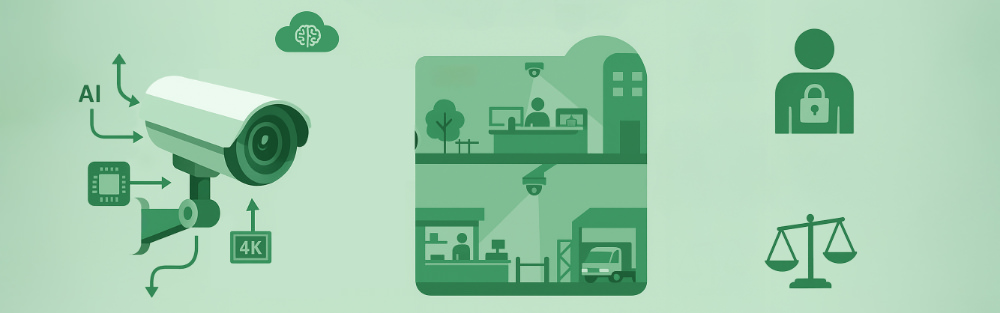
Video surveillance has evolved from simple analog systems with low-resolution images to advanced, intelligent network-based solutions that utilize AI, cloud technology, and edge analytics.
Surveillance Camera Systems
As both technology and regulations have developed, it has become increasingly important to understand the various components of a surveillance camera system – from image quality and storage to the handling of personal privacy.
What Is a Surveillance Camera System?
A surveillance camera system typically consists of cameras, recording and storage equipment, and software to manage and analyze video footage. These systems can be used to prevent crime, enhance security, or improve operational processes across sectors such as retail, industry, and public services.
Resolution and Recording Options
Camera resolution is one of the most fundamental factors for image quality. Common resolutions include:
- HD (720p): Suitable for basic surveillance.
- Full HD (1080p): Standard choice for most modern systems.
- 4K (2160p): Offers high detail, ideal for large areas or critical zones.
- Thermal and IR cameras: Used in dark environments or to detect heat signatures.
Recording can be continuous, motion-triggered, or scheduled. Modern systems also offer event-based recording, where AI determines when to start recording.
Camera Technology for Challenging Environments
Surveillance must often operate in harsh conditions – both indoors and outdoors. Specific technologies and designs ensure reliable image quality in difficult environments.
Backlighting and High Contrast
In areas with strong light variations – such as glass entrances, parking garages, or places with shifting daylight – WDR (Wide Dynamic Range) is used. WDR allows the camera to balance bright and dark areas in the same image, ensuring accurate rendering of both
Vibrations and Movement
In locations with vibrations – such as industrial sites, bridges, or public transport – camera images can become shaky and hard to interpret. For such environments, cameras feature:
- Image stabilization technology (EIS/OIS) to counteract shake digitally or optically.
- Vibration-resistant mounts and housings to protect against shock and movement.
- Rugged designs with industrial ratings, such as EN50155 for railway use.
Weather Protection and Temperature Variations
Outdoor cameras are weather- and vandal-resistant, compliant with IP66/67 and IK10 standards. Some models also offer:
- Built-in heating and cooling systems for operation in extreme temperatures (−40 °C till +60 °C).
- Resistance to dust, moisture, snow, and UV light, critical for long-term operation in Nordic climates.
Low Light and Night Conditions
For nighttime surveillance:
- IR cameras with infrared LEDs allow visibility in complete darkness.
- Starlight cameras provide color images in very low light using highly sensitive sensors, large apertures, and noise reduction.
- Thermal cameras detect heat signatures regardless of lighting – useful in forests, marine environments, or perimeter security.
Storage – Local, Cloud, or Hybrid Solutions
Video footage can be stored in several ways:
- Local storage (NVR/DVR): Stored on-site, typically on hard drives in a network video recorder (NVR) or digital video recorder (DVR).
- Cloud storage: Video streams are sent to an external server via the internet, allowing remote access and easier scaling.
- Hybrid solutions: Combine local and cloud storage for redundancy and flexibility.
The choice impacts not just cost, but also data security and internet connectivity requirements.
System Management – Local, Cloud, and Edge Technology
A surveillance system requires a management interface (VMS – Video Management System), which can be installed locally or accessed via web browsers in the cloud.
- Server-based management: Requires local server infrastructure, offering high control.
- Cloud-based management: Flexible and scalable, but reliant on connectivity.
- Edge computing: Video processing occurs directly in the camera or close to the data source, reducing the need to transmit large data volumes and enabling faster decision-making.
Beyond Security – New Business Value with Video Analytics
Traditionally, surveillance systems were used to enhance safety and prevent crime. Today’s technology allows them to also contribute to business optimization, sustainability efforts, and strategic development.
Efficiency and Process Control
In retail, warehouses, and production environments, cameras can analyze workflows and identify bottlenecks. For example:
- Measure queue lengths and optimize staffing in retail.
- Analyze machine usage in factories to reduce downtime.
- Monitor work routines and improve logistics in real time.
Cost Savings
By combining camera data with AI, companies can make data-driven decisions that lower costs:
- Reduce energy consumption by detecting empty areas with active lighting systems.
- Identify misuse of equipment to reduce wear and tear.
- Automate control functions that would otherwise require manual oversight.
Sustainability and Environmental Goals
Surveillance can also support organizations’ environmental initiatives:
- Detect resource waste, such as identifying half-full or empty transportation.
- Monitor waste stations to ensure proper sorting.
- Optimize energy use by controlling lighting, heating, and ventilation based on presence.
Intelligent Systems with AI and Video Analytics
Thanks to AI and machine learning, surveillance has become proactive. Common applications include:
- Object and facial recognition
- Movement pattern analysis
- Intrusion detection
- Gender and age estimation
- Counting people and vehiclesn
Analytics can occur directly in the camera (edge), on a local server, or in the cloud. The choice depends on requirements for response time, bandwidth, and data privacy.
Anonymization and Privacy Protection
Privacy protection is increasingly important. Anonymization techniques include:
- Real-time masking of faces or bodies
- Blurring of sensitive areas
- Automatic deletion after a certain time
Anonymization is especially important in public spaces and during AI analysis, where personal data could otherwise be processed unlawfully.
Conclusion
Modern surveillance is much more than just recording video. It’s a fusion of advanced technology, AI-powered analytics, and legal responsibility. Choosing the right system means balancing technical needs with privacy considerations and legal requirements – while also thinking long-term about scalability, security, efficiency, and sustainability.
Source: SECURITY WORLD MARKET